
Hebei Shougang Qian'an Iron & Steel Co., Ltd.
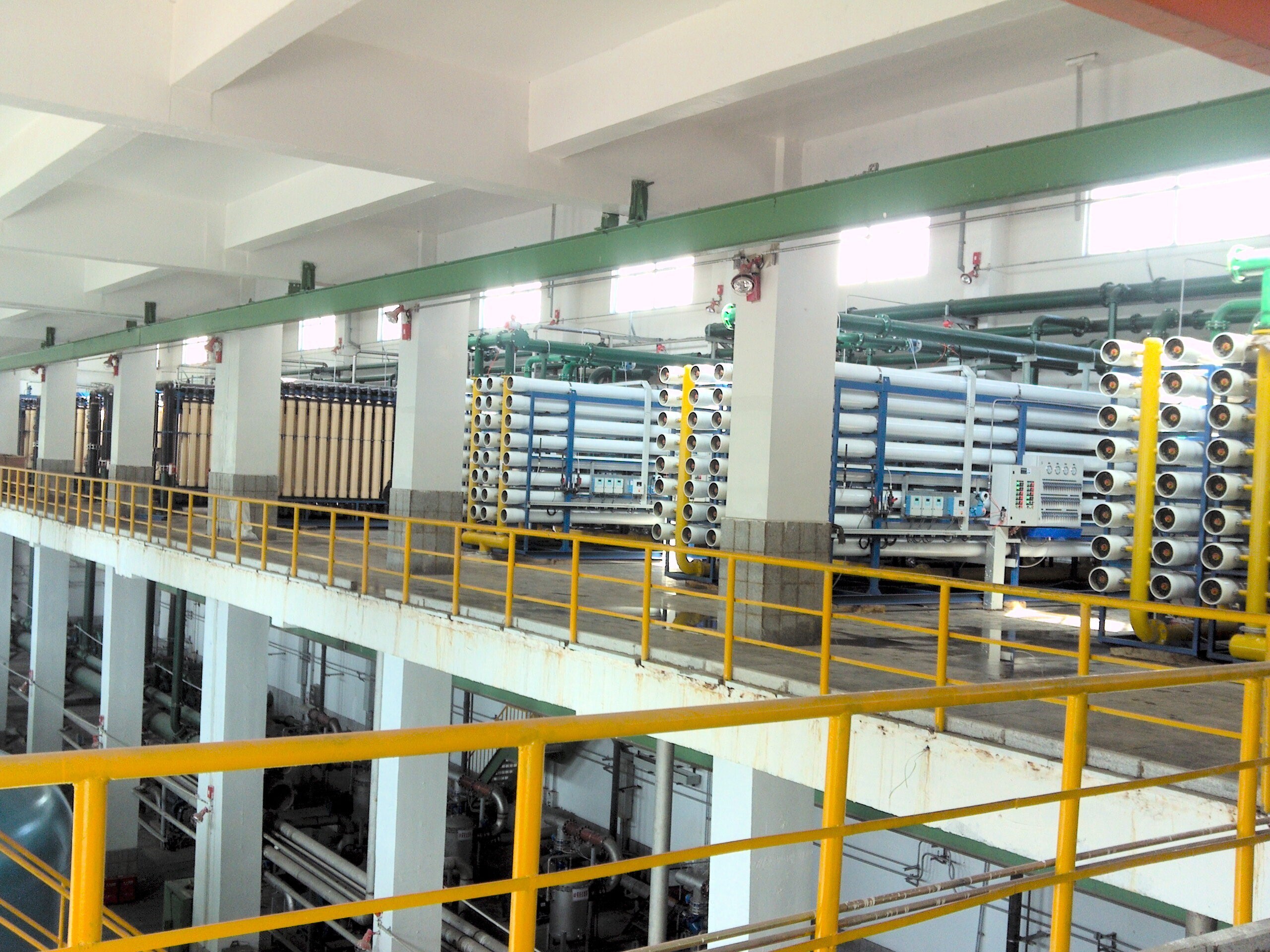 Location: China
Total capacity: 1300 m3/hr permeate
Feed water source: Surface water
Treated water application: Process water
Challenge: High scaling, high organic fouling and high biofouling potential
1. Introduction
Hebei Shougang Qian'an Iron & Steel Co Company is a large producer of iron and steel.
A Reverse Osmosis (RO) system was installed in 2010 as the client needed high purity water for their production process. In order to reduce the RO concentrate discharge volume of the water treatment plant, the client installed a second RO system (brine concentrator) treating the concentrate of the existing RO system (primary system). The brine concentrator system was installed in 2014.
Primary water treatment system
The feed water source is surface water.
The pretreatment of the primary water treatment system consists of dual media filtration (DMF), ultrafiltration (UF) and cartridge filters upstream of the reverse osmosis system.
Poly aluminum chloride (PAC), poly acryl amide (PAM), Ca(OH)2 and antiscalant Checkmate CP118 are continuously dosed.
The treated water quality after the UF system has 700 mg/l TDS, a turbidity of 0.65 NTU, 17mg/l COD and 3.0 x 10⁶ cfu/ml (total micro count). The organic matter consists of natural occurring organics (such as humic acids) and other organics such as oil.
The primary RO system produces 1000 m3/hr permeate at a recovery of 65%.
The primary RO system consists of 5 RO skids. Each RO skid produces 200 m3/hr permeate.
Each RO skid contains 48 pressure vessels and 288 Hydranautics PROC 10 reverse osmosis membrane elements.
Brine concentrator system
The feed water is the concentrate from the primary RO system.
The pretreatment consists of DMF and cartridge filters.
Bleach, sodium bisulphite and the antiscalant Checkmate NP218 are continuously dosed. A shock dosage of Ochemate TBC9527 is applied daily for 30 minutes.
The brine concentrator RO system produces 300 m3/hr permeate at a recovery of 50%.
The brine concentrator RO system consists of 3 RO skids. Each RO skid produces 100 m3/hr permeate.
Each RO skid contains 36 pressure vessels and 216 Hydranautics LFC3-LD reverse osmosis membrane elements.
2. Challenge
The raw feed water quality is a challenge for the water treatment systems as it has a high organic fouling, a high biofouling and a high scaling potential.
3. Solution
Ochemate carried out an evaluation of the feed water prior to the start-up of the primary water treatment system and the brine concentrator system.
The recommended antiscalant for the primary RO and the concentrator RO system were respectively Checkmate CP118 and NP218.
In order to minimize the biofouling potential of the brine concentrator, a shock dosage of a fast acting non oxidizing biocide TBC9527 was recommended.
Since the start-up of the primary system in 2010 and the brine concentrator in 2014, the Ochemate products have been applied.
The cleaners ROgain751 and 711 are used for the maintenance cleanings of the primary RO and the brine concentrator systems. The fast acting non oxidizing biocide TBC9528 is seasonally incorporated in the cleaning procedure.
Table 1 contains some normalized performance data of a primary RO before and after cleaning.
Table 1. Performance data before and after the cleaning of a primary RO unit
|
Pressure
MPa
|
Flow
m3/hr
|
Conductivity
S/cm
|
Recovery
%
|
System
rejection
%
|
||||
| Feed | Concentrate | Concentrate | Permeate | Feed | Permeate | |||
| interstage | Final | |||||||
| 1.28 | 1.18 | 1.05 | 107 | 176 | 1315 | 15.9 | 62 | 98.8 |
| 0.73 | 0.65 | 0.54 | 102 | 191 | 1208 | 14.8 | 65 | 98.8 |


